
On this page:
E-scooters and other personal mobility devices are a convenient way to travel around Canberra. Whether you use your own device or use a shared e-scooter, it’s important to understand the rules for riding safely and legally in the ACT.
Under The ACT Road Rules, e-scooters are classified as personal mobility devices. Other personal mobility devices include those powered by an electric motor such as e-skateboards and motor-assisted roller skates or rollerblades.
E-scooters and other personal mobility devices can be a safe, affordable and sustainable way to travel.
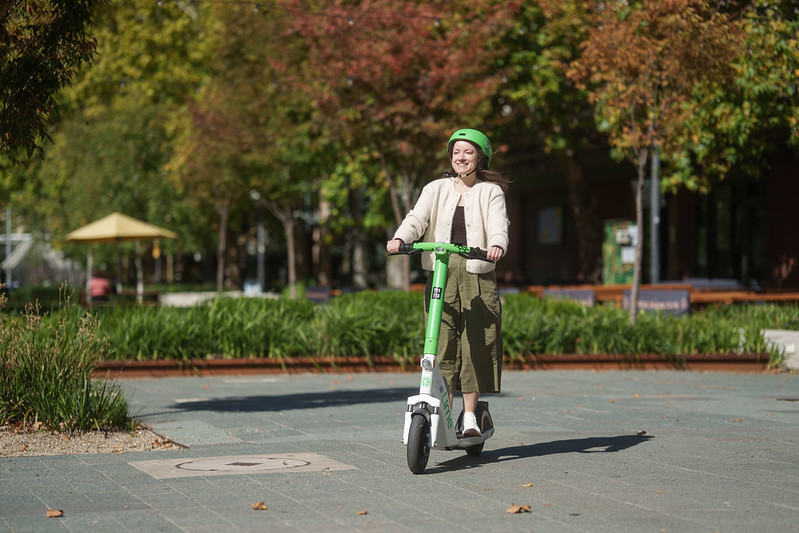
You can ride your own e-scooter or hire a Lime e-scooter. View the micromobility (e-scooter and e-bike) operation area map to see where shared e-scooters operate.
If you plan to buy an e-scooter, make sure it meets Australian standards and ACT legal requirements before purchasing it. Some e-scooters sold in Australia or online cannot legally be used on public roads or paths in the ACT.
Different rules apply for bikes, e-bikes and non-motorised devices such as skateboards, scooters, rollerblades and roller skates. For more information about bikes, e-bikes and other devices, please visit the Cycling page.
For detailed legal requirements in the ACT, see Road Transport (Road Rules) Regulation 2017.
E-scooter rules and safety tips
If you ride an e-scooter or other personal mobility device, you must follow these rules. They help keep riders, pedestrians and other path users safe.
- Wear a helmet. You must wear an approved safety helmet when riding.
- Don't ride under the influence. Riding under the influence of drugs or alcohol is illegal and dangerous.
- Mobile phones. Do not use your phone while riding.
- Warning devices. You must have a warning device, such as a bell, fitted to your device or within easy reach while riding.
- Safety equipment. You must have lights and reflectors on either the device or your person at night or in hazardous weather conditions.
- One person per e-scooter. You must not carry any passengers.
- Give way. You must give way to pedestrians and keep to the left. Everyone shares a responsibility to use roads and paths safely and respectfully.
- Age restrictions. Children under the age of 12 must be supervised by an adult when using a personal mobility device. The Lime shared e-devices can only be used by people aged 16 years and over.
- Ride to the conditions. Always ride at a safe speed. Slow down when paths are busy, visibility is poor or conditions are unsafe.
- Park sensibly. Park your device so it does not block paths, stairs, ramps, public transport stops or building entrances.
- Know where you can ride. E-scooters can only be used in permitted locations.
Permitted e-scooter devices
E-scooters are allowed to be used in public places in the ACT, if they meet the following requirements:
- powered by an electric motor
- designed for one rider only
- weigh 60 kg or less (without a rider)
- have one or more wheels
- have a braking system
- have a maximum speed of 25 km/h on level ground
- no larger than 1250 mm long, 700 mm wide and 1350 mm high
If your e-scooter does not meet all of the requirements, it cannot be used on public roads or paths in the ACT. It may only be used on private property.
Any personal mobility device that travels more than 25 km/h is considered a motor vehicle and is therefore forbidden from travelling on paths.
Permitted e-scooter locations
E-scooters may be used on footpaths, shared paths or nature strips. They can also be used on private property.
E-scooters are only permitted on roads if there is no footpath, shared path or nature strip next to the road or if it is not practical or safe to use those areas. If you must travel on a road, take the shortest practical route and return to an approved path as soon as possible. Do not stay on the road for longer than necessary.
Speed limits
If you are using an e-scooter or other personal mobility device, you must stick to the speed limits. It is illegal to travel faster than:
- 15 km/h on footpaths
- 25 km/h on shared paths, bicycle paths or the bicycle side of separated paths.
You must slow down to 10 km/h when approaching and travelling across a crossing.
To ensure everyone can use outside areas safely, e-scooter riders are encouraged to slow down when travelling through congested spaces. Riders must give way to pedestrians and pedestrians should also remain aware of their surroundings. Signage is installed in high traffic areas to help remind riders to slow down and share the space safely with pedestrians.
Dedicated e-device parking zones
Respect others when you ride and park. Keep paths clear, park considerately and be mindful of other path and road users. Dedicated e-scooter and e-bike parking zones are available at Petrie Plaza near London Circuit. These dedicated parking zones help ensure shared e-devices are not parked in a way that can become a hazard.
Public transport
Light rail
Some bikes, scooters and mobility devices can be carried on light rail services, subject to conditions. Information about permitted bikes, scooters and other mobility devices is available on the CMET website. Please note that shared Lime e-scooters and e-bikes cannot be taken on board light rail services.
Buses
E-scooters and other personal mobility devices cannot be placed in the bike racks at the front of the bus but may be brought onto buses at the driver’s discretion. If taken on board, personal mobility devices must meet carriage of goods requirements.
Lime e-scooters and e-scooter that cannot be folded are not permitted on board Transport Canberra buses.
Scooters, rollerblades, roller skates and skateboards (wheeled recreational devices)
Wheeled recreational devices do not have a motor. You must follow the road rules when using wheeled recreational devices. This includes travelling on roads with:
- a dividing line or median strip;
- a speed limit over 50 km/h; and
- a one-way road with more than 1 marked lane.
Do not use the part of a separated footpath designated for pedestrians (keep to the side for cyclists). Keep left and give way to pedestrians.
Please see the Road Transport (Road Rules) Regulation 2017 for more details.